AI assistants
Answers your customers and staff can trust, with the source shown.
Assistants for customer support, internal knowledge and lead qualification. They answer from your own policies, manuals and data, and hand over to a person when they should.
The problem
The problem isn't a lack of answers. It's finding the right one, fast, and being able to prove it.
The same questions reach your support desk, your sales team and your most experienced people every day. The answers exist, buried in PDFs, wikis and old emails. Generic chatbots make it worse: they answer confidently from nowhere, and nobody can check where an answer came from.
What we do
What it does, working as one system.
-
Grounded answers
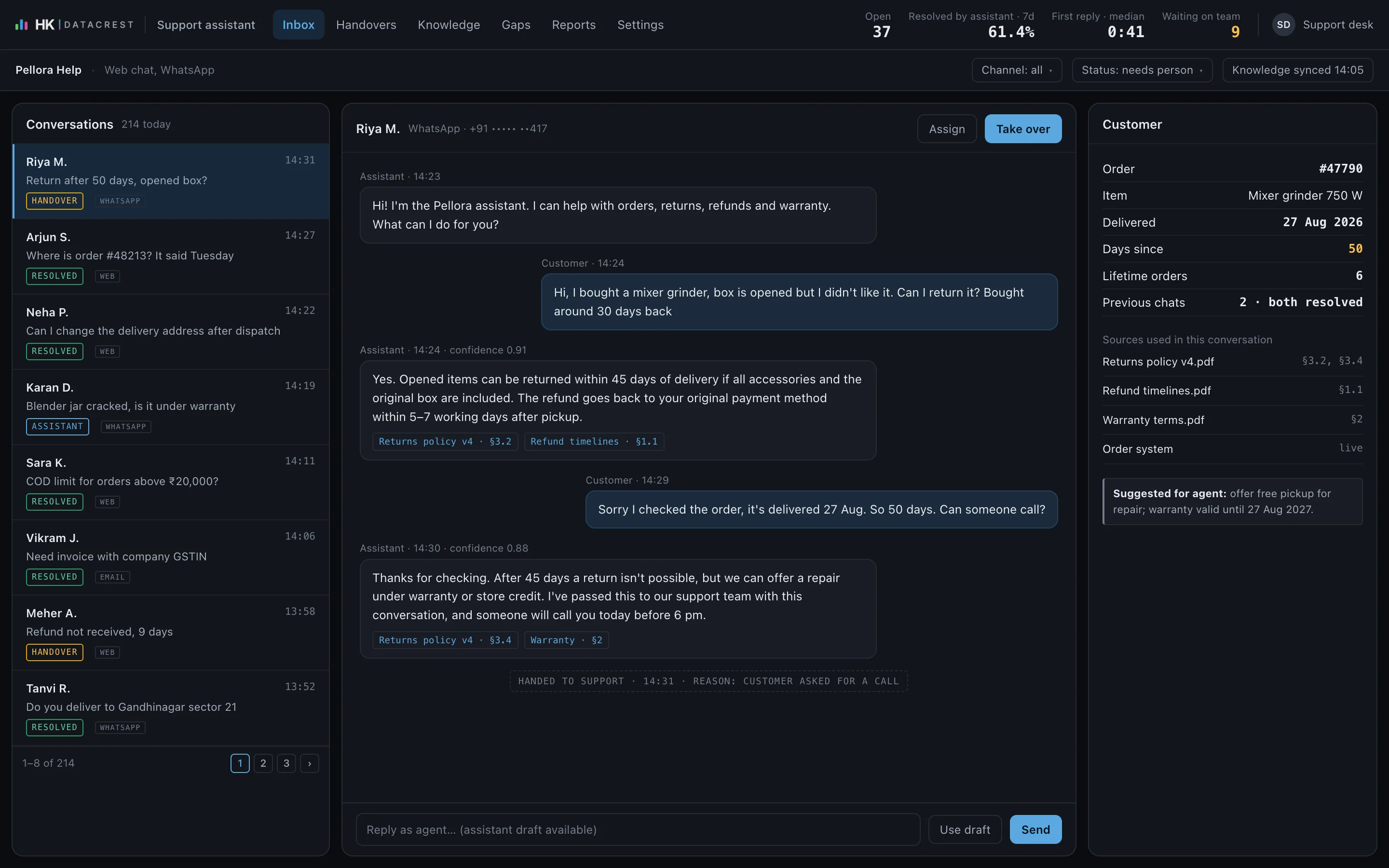
Every answer is built from specific passages in your documents, and cites them.
-
Clear handover
Rules for what it may answer and when a person takes over, with the full conversation passed on.
-
Lead qualification
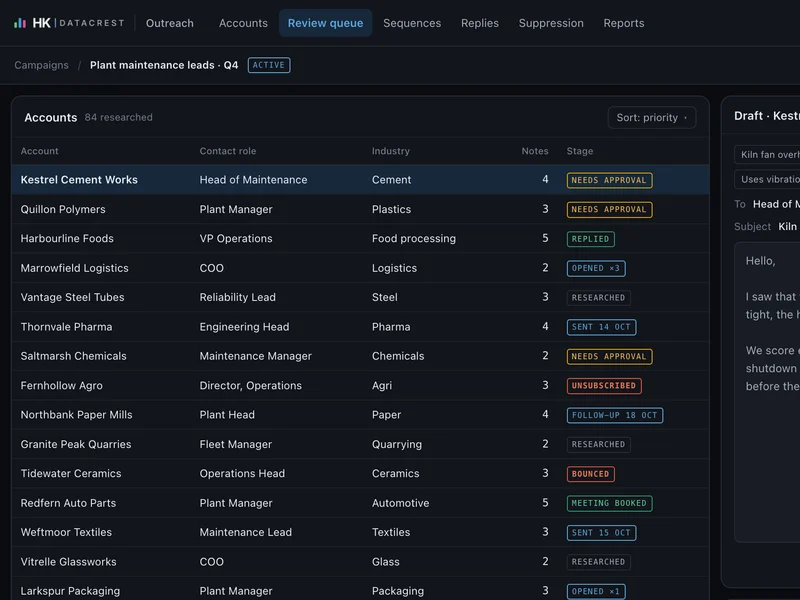
The questions your sales team would ask, asked consistently, with answers logged.
-
Gap reports
A review screen showing what people ask, what it couldn't answer and which documents are missing.
How it works
From your data to a working system.
Gather the sources
The documents and data it may answer from, and what is off limits.
Ground and index
Content is split, indexed and kept in sync, so each answer traces to a passage.
Set the rules
Tone, refusals, handover triggers and the details to collect.
Launch and review
On your website, WhatsApp or internal tools, reviewed weekly against real questions.
What changes
What you get from it.
- Fewer repeat questions for your team. People handle the conversations that need a person.
- Answers you can audit. Every reply points to its source.
- No confident guessing. When the documents don't cover it, it says so and hands over.
- Your documents get better. Gaps show up as a list, not as complaints.
How we engage
Start small. Decide with evidence.
-
Prove it on your data
One channel and one body of documents, such as your returns and warranty policies, live with a small group of users before wider rollout.
Fixed scope · fixed price · agreed before work starts
-
Roll it out
If the pilot earns it, we build the full system, connect the rest of your data and bring your team onto it.
Only if the pilot earns it
-
Run it, or own it
We keep it running and improving, or hand it over with the code, the documentation and a runbook.
Your code · your data · your cloud account
Questions
What people ask before a first call.
Which AI model do you use?
Whichever fits the job: Claude and other models on Amazon Bedrock, OpenAI models on Azure OpenAI, or Google Gemini on Vertex AI. On Bedrock, your data stays within AWS and is not shared with the model provider. We choose on cost, speed and quality.
Is our data used to train the model?
No. Neither we nor AWS Bedrock use your prompts or documents to train models.
Start with a conversation
Tell us what's slowing your operation down.
A 30-minute call with the people who would build it. You leave knowing whether a pilot makes sense, and what it would cover.