Delivery route planning
Fewer kilometres, full vans, and drivers home on time.
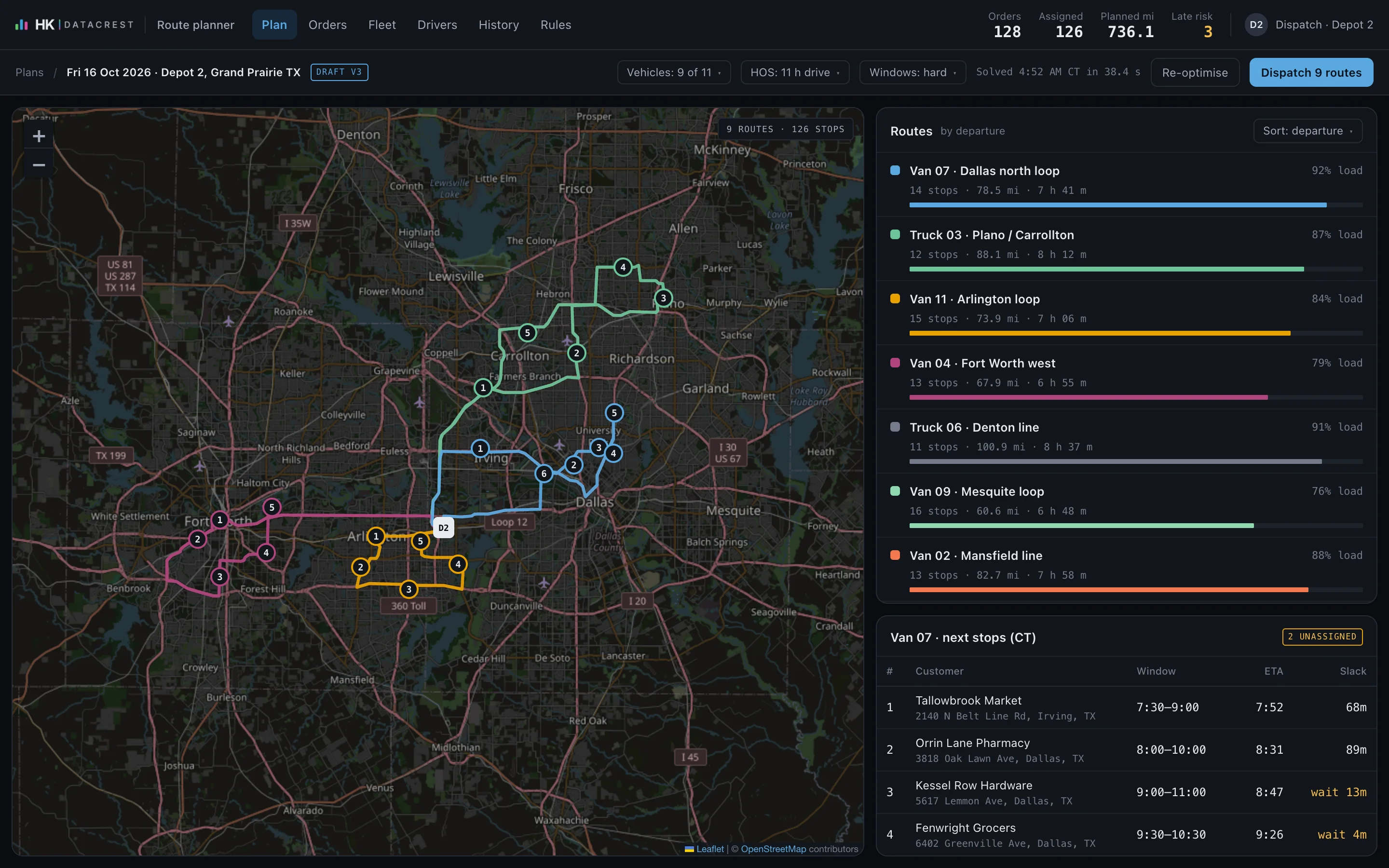
Daily routes planned around delivery windows, vehicle capacity and shift hours, and replanned in minutes when the day changes.
The problem
The plan is only as good as the one person who knows how to make it.
Tomorrow's routes get built in a spreadsheet or in one dispatcher's head. It holds until volume grows, a driver calls in sick or a big order lands at ten in the morning. Then vans run half empty, shifts run over and customers stop trusting the ETA.
What we do
What it does, working as one system.
-
Constraint-aware planning
Delivery windows, vehicle capacity by weight and volume, shift and weekly hour limits, depot times and stops that must travel together.
-
Replanning in minutes
New orders, cancellations or a vehicle off the road, and the plan is rebuilt without starting from scratch.
-
Dispatcher control
Move a stop by hand and see the effect on distance, load and hours immediately.
-
Hand-off to drivers
Routes go out to driver apps or your dispatch system, with ETAs your customers can rely on.
How it works
From your data to a working system.
Bring in the orders
Orders, stops, vehicles and drivers come from your order system or a daily upload.
Set the rules
We write your real constraints down with your dispatch team, including the unwritten ones.
Plan and compare
The planner builds routes and shows each one's distance, load and hours next to your current plan.
Dispatch
Dispatchers adjust, approve and send routes to drivers.
What changes
What you get from it.
- Plans that obey every rule. No route that breaks a window, a load limit or a driver's hours.
- Changes absorbed, not dreaded. A late order is a replan, not a phone marathon.
- Planning that doesn't depend on one person. The rules live in the system, not in someone's head.
- Numbers to manage by. Distance, load and hours per route, every day.
How we engage
Start small. Decide with evidence.
-
Prove it on your data
Run the planner on a few weeks of your past orders and compare its plans, route by route, with what your vans actually drove.
Fixed scope · fixed price · agreed before work starts
-
Roll it out
If the pilot earns it, we build the full system, connect the rest of your data and bring your team onto it.
Only if the pilot earns it
-
Run it, or own it
We keep it running and improving, or hand it over with the code, the documentation and a runbook.
Your code · your data · your cloud account
Questions
What people ask before a first call.
Do we have to replace our order system?
No. The planner reads orders from what you already use and hands routes back to it.
How are breaks and hour limits handled?
Shift length, weekly limits and breaks are constraints in the plan, so a route that would break them is never proposed.
Start with a conversation
Tell us what's slowing your operation down.
A 30-minute call with the people who would build it. You leave knowing whether a pilot makes sense, and what it would cover.