Cloud and AWS
Finding where an AWS bill goes, then making it smaller.
A growing company spending about $5,000 a month on AWS across three accounts usually has a setup that grew one project at a time: always-on EC2 servers running nightly jobs, a development database running around the clock, and costs nobody can assign to a team.
- Industry
- Cloud and AWS
- Solutions
- Spend less and run better on AWS · Put all your numbers in one place
- Engagement
- Pilot, then build and run
The challenge
The bill goes up every quarter, and nobody can say why.
Permissions are wider than they should be, logs are kept forever, and a failed nightly job is only noticed when a report is missing the next morning. The team wants to move more work to AWS but does not trust the current setup enough to build on it.
The approach
How it works.
Review
Accounts, IAM, network, architecture and twelve months of cost data are reviewed and written up in plain language.
Rank the savings
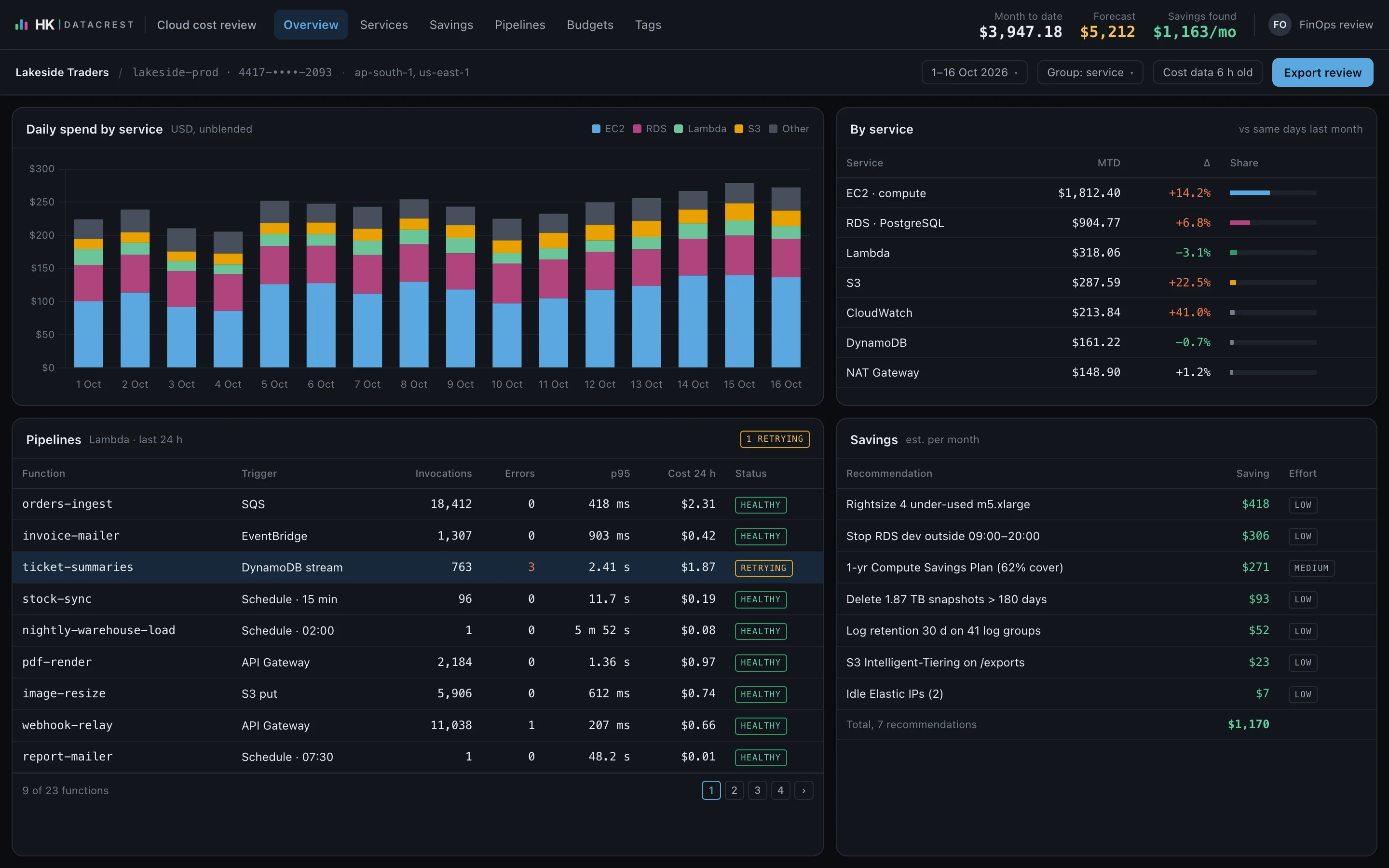
Every saving is sized and ranked by effort: rightsizing, schedules for non-production, Savings Plans, snapshot and log clean-up.
Move the jobs
Nightly batch jobs move from always-on servers to Lambda, SQS and EventBridge, with retries, alerts and per-job cost visible.
Hand over
Budgets, cost alerts, runbooks and least-privilege roles, so the team can run it or we keep running it.
The solution
What gets built.
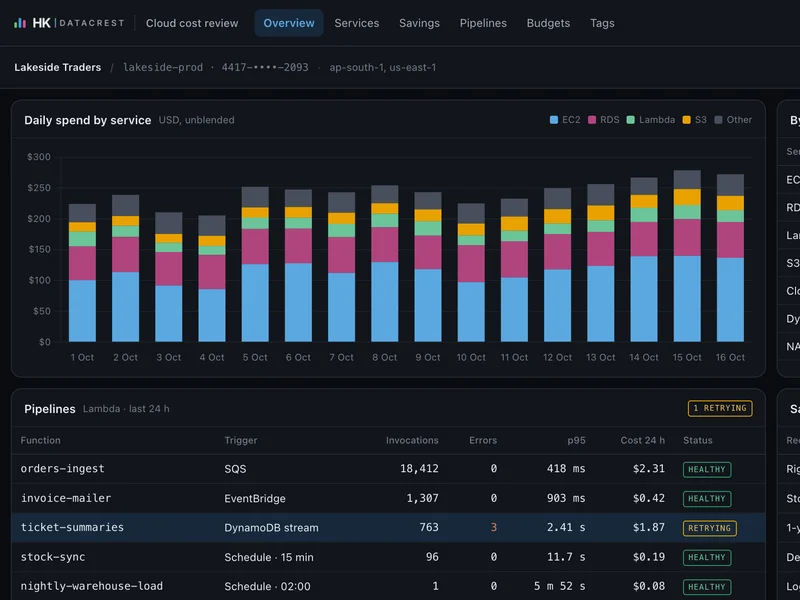
The solution is a cost and pipeline review dashboard plus the changes themselves: daily spend by service, cost by service against last month, the health of every Lambda pipeline, and a ranked list of savings with their effort.
Outcomes
What it delivers.
- A bill you can explain with every major cost tagged to an owner.
- Savings ranked by size and effort so the easy wins happen first.
- Nightly jobs that report their own failures before anyone notices a missing report.
- Access you can defend least privilege, MFA and documented roles.
Technology
Typical stack for this.
Related solutions
The solutions behind it.
Start with a conversation
Tell us what's slowing your operation down.
A 30-minute call with the people who would build it. You leave knowing whether a pilot makes sense, and what it would cover.