Mining
Seeing the next haul-truck failure before it costs a shift.
An open-pit mine running 26 haul trucks, four excavators and a crushing circuit across two shifts faces a familiar split: oil samples go to a lab every 250 hours, vibration routes run monthly, pre-start checks are on paper, and fuel and dispatch data sit in two separate systems.
- Industry
- Mining
- Solutions
- Know which assets need attention first · Put all your numbers in one place
- Engagement
- Pilot, then build and run
The challenge
The warning signs are in the oil samples. They just reach the planner too late.
Unplanned stand-downs cost a shift of tonnes each time, and maintenance planning leans on hour counters rather than condition. Supervisors spend the end of every shift assembling fuel and production numbers by hand, and pre-start defects are easy to lose between shifts.
The approach
How it works.
Bring the signals together
Oil analysis, vibration, payload, fuel dispensing and dispatch exports are loaded for every unit, alongside the maintenance history.
Write the rules per class
A scoring ruleset is written with the maintenance team for haul trucks first, then excavators and conveyors.
Rank and plan
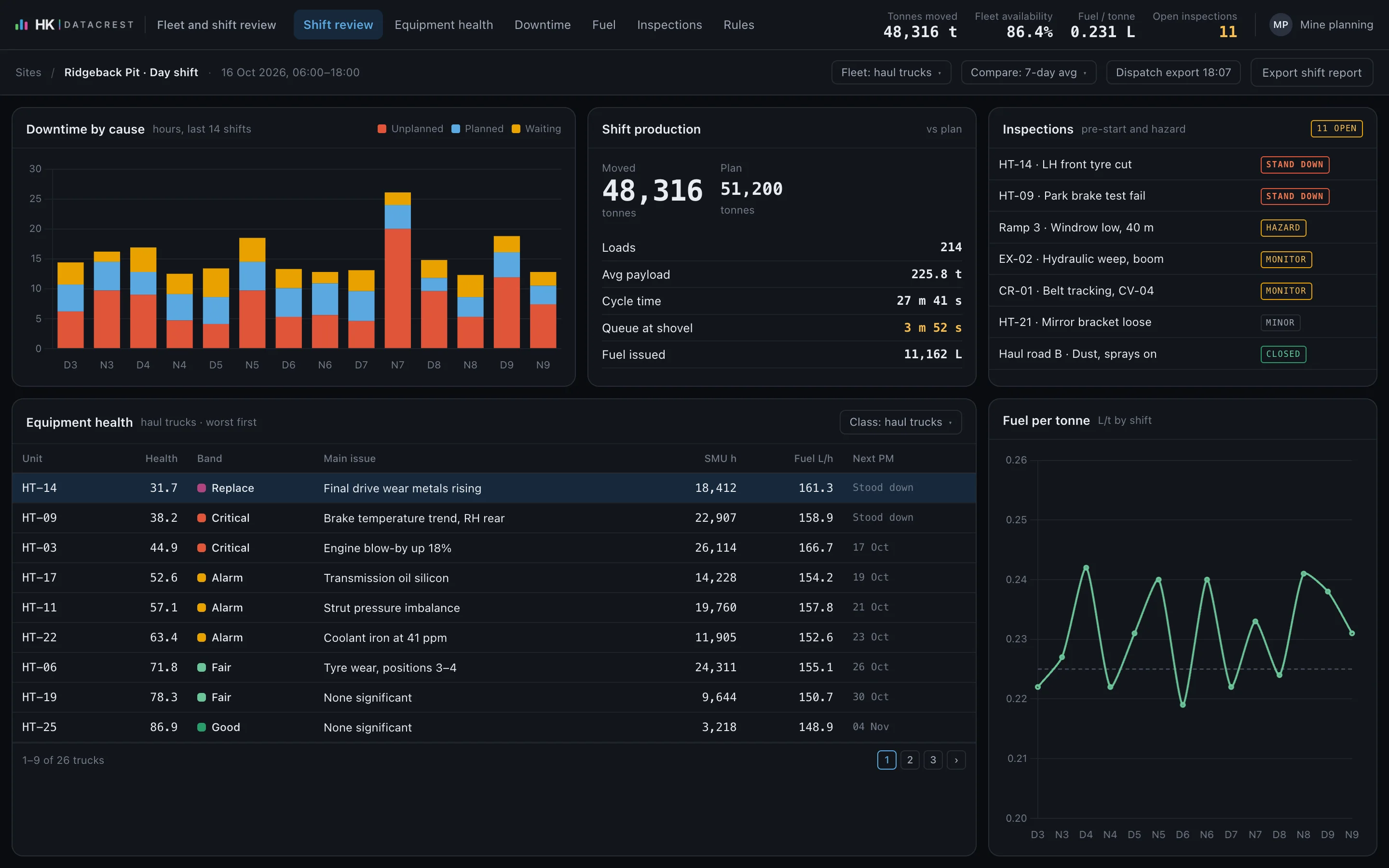
Each truck gets a health score and a main issue, and downtime is logged by cause so planned work replaces surprises.
Close the shift loop
An automatic end-of-shift report covers tonnes, loads, fuel per tonne and open inspection items, and pre-start defects are captured by phone and tracked to close-out.
The solution
What gets built.
The solution combines our asset scoring engine with data pipelines and a simple phone capture for inspections. One review screen shows downtime by cause, shift production, fuel per tonne, open inspections and the fleet ranked worst first.
Outcomes
What it delivers.
- Condition-based maintenance planning so shutdown lists are ranked by risk, not by hour meter alone.
- Downtime explained by cause so the biggest causes get fixed first.
- An end-of-shift report that builds itself so supervisors spend the handover on the work, not the spreadsheet.
- Defects tracked to close-out so a pre-start finding cannot disappear between shifts.
Technology
Typical stack for this.
Related solutions
The solutions behind it.
Start with a conversation
Tell us what's slowing your operation down.
A 30-minute call with the people who would build it. You leave knowing whether a pilot makes sense, and what it would cover.