Healthcare
Filling empty clinic slots before they go to waste.
For an outpatient network of four clinics offering physiotherapy, orthopaedic and dietetics sessions, about 1,300 bookable slots a week, bookings live in the clinic management system, rosters in a shared spreadsheet and the waitlist on a printed list at each front desk.
- Industry
- Healthcare
- Solutions
- Put all your numbers in one place · Answer questions from your own documents
- Engagement
- Pilot, then build and run
The challenge
Patients wait for appointments that go unused every day.
Missed appointments leave clinicians idle while the waitlist grows. Front-desk staff have no way to see which bookings are at risk, and matching a cancelled slot to the right waiting patient takes phone calls across four sites.
The approach
How it works.
Agree the boundaries
Patient details stay in the clinic system. The scheduling view works on appointment IDs, slot types and rosters, and any wider data use needs the network's compliance sign-off in writing.
Model utilisation
Bookable slots, bookings and attendance history are loaded per clinic, clinician and session type.
Flag risk, act early
Each upcoming booking gets a no-show risk based on its history, and the highest-risk ones get a call rather than only an SMS.
Fill the gaps
Open and cancelled slots are matched to suitable waitlist entries, ready for the front desk to offer.
The solution
What gets built.
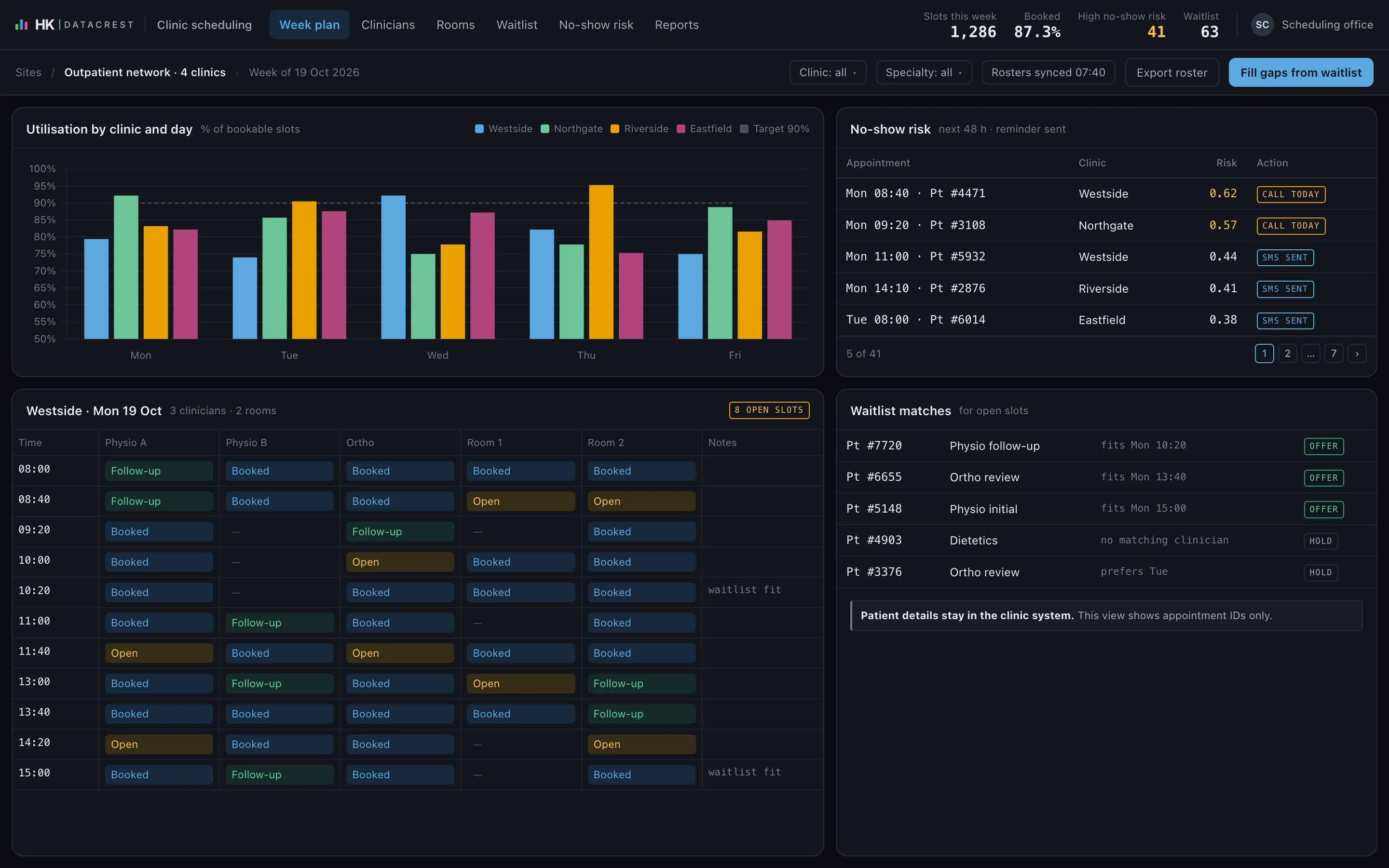
The solution is a scheduling dashboard on top of the clinic's own system: utilisation by clinic and day, a no-show risk list for the next 48 hours, each clinic's day by clinician and room, and waitlist matches for open slots.
Outcomes
What it delivers.
- More of every week's slots used by acting on risky bookings and open gaps early.
- Front desks working from one list instead of four printed waitlists.
- Patient data kept where it belongs with the scheduling view working on IDs.
- Clear numbers for managers utilisation and attendance per clinic, each week.
Technology
Typical stack for this.
Start with a conversation
Tell us what's slowing your operation down.
A 30-minute call with the people who would build it. You leave knowing whether a pilot makes sense, and what it would cover.