Solar reports and MIS
Daily generation reports and monthly MIS, without the spreadsheet work.
HKDataCrest Solar drafts each plant's daily generation report (DGR) from the day's data. Your team checks it, and it is emailed to the owner. Monthly MIS reports and JMR reconciliation come from the same figures. Reports can be written into the Excel format your clients already use, with their logos and formulas left as they are.
The problem
The DGR takes an engineer two hours a day, and it is still late.
Exports from each portal, the meter reading from site, the irradiation from somewhere else, all pasted into a workbook that has grown for years. At month end the same work happens again for the MIS, and then the DISCOM's joint meter reading doesn't match and nobody knows why.
What it does
Reports that write themselves, and still get checked.
-
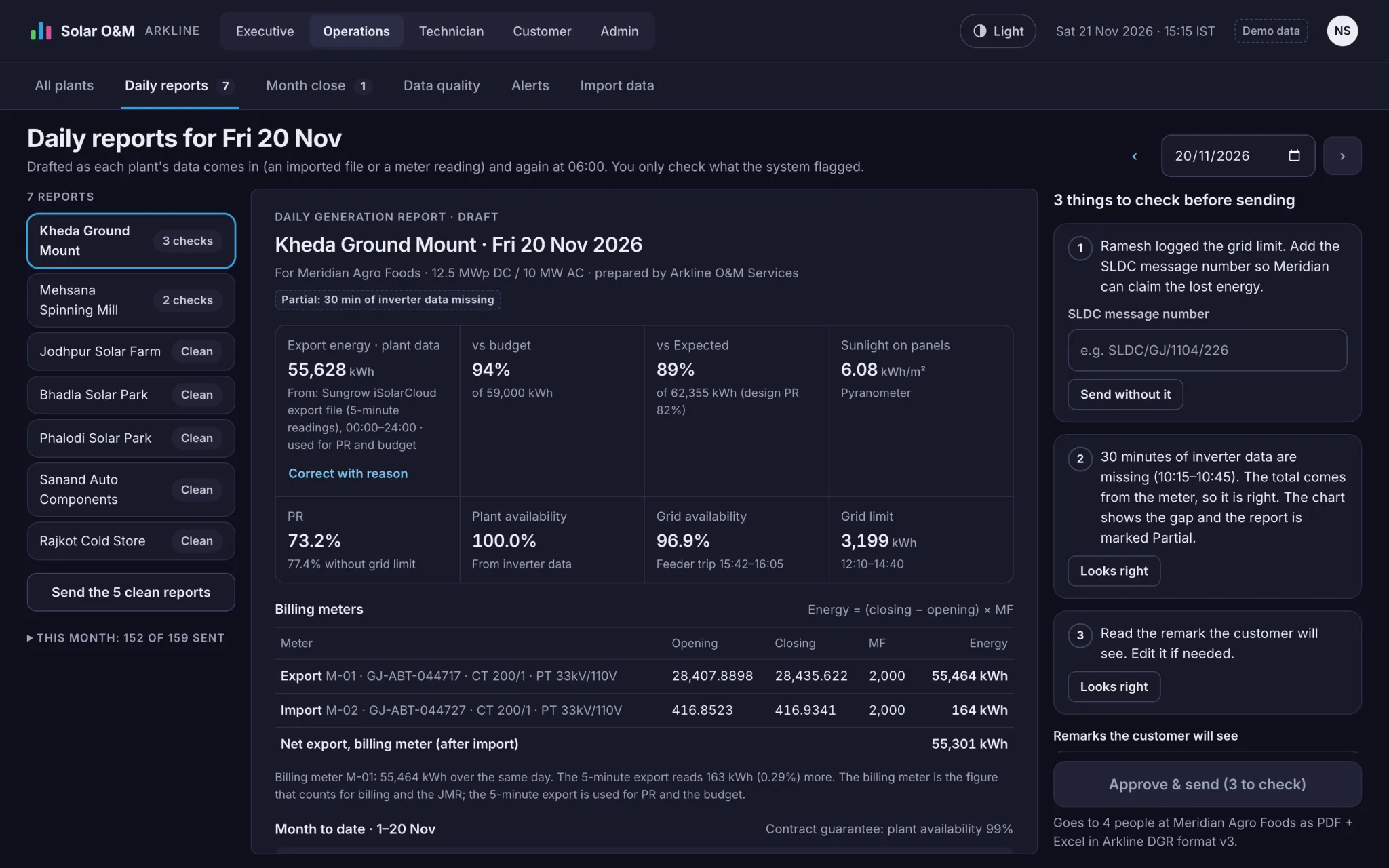
Daily generation report
Drafted every morning from the day's data: energy, irradiation, PR, availability, losses by cause and events with their times. Checked, then sent.
-
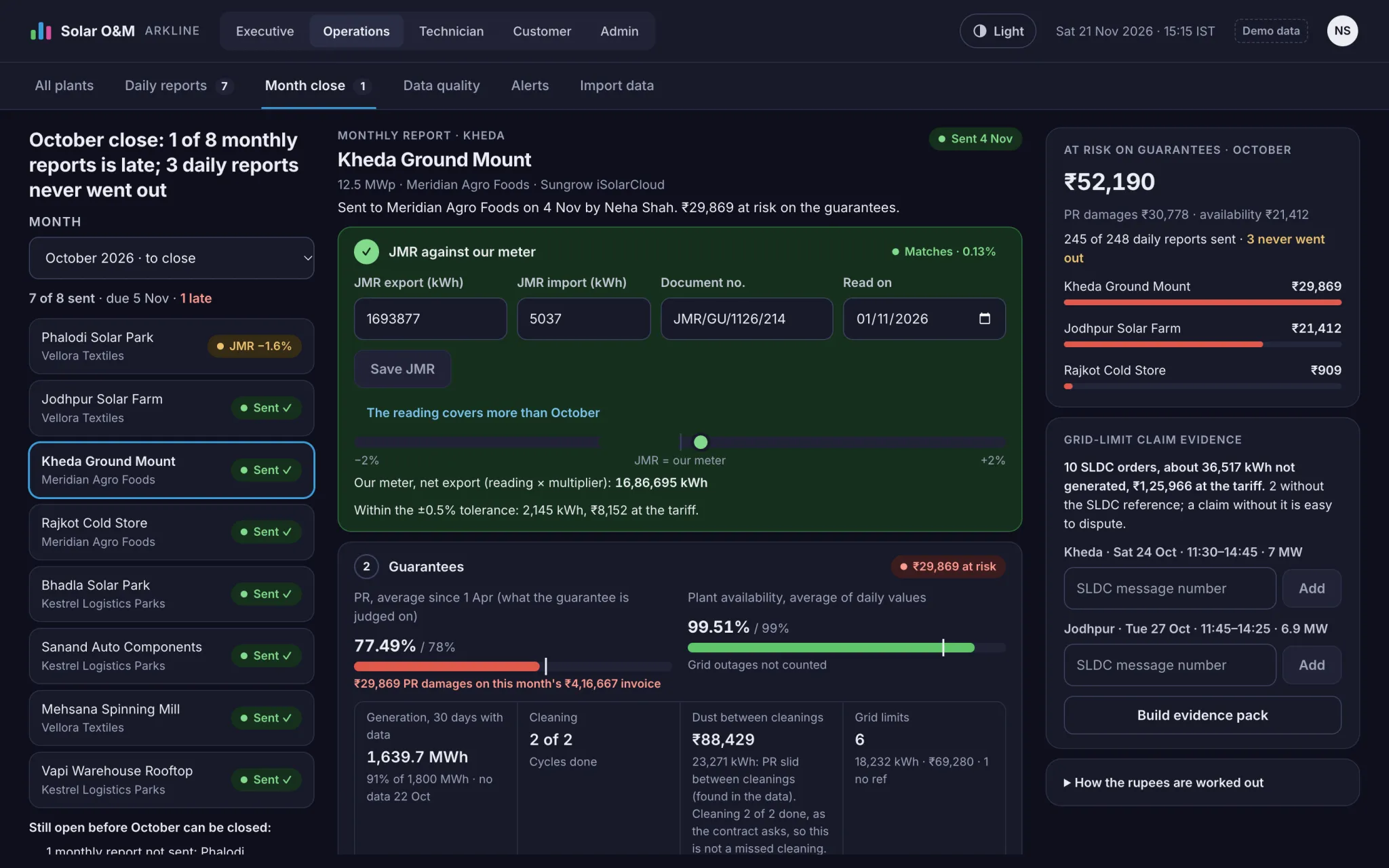
Monthly MIS
Generation against budget, contract PR against the guarantee, plant availability and JMR, for each plant and the portfolio.
-
JMR reconciliation
The DISCOM's joint meter reading against your own meter for the month, as a difference in kWh, in percent and at tariff.
-
Your own Excel format
Upload the workbook you send today. Fields are mapped to its labels once, and every report fills a copy of it.
Reports you can stand behind
A report never goes out on numbers nobody trusts.
Meter energy is worked out as closing minus opening register, times the multiplying factor, with a register rollover handled. Where the billing meter and the portal disagree by more than 1% for a day, the report says so.
If the plant's irradiance sensor is suspect, the daily report asks before it can go, and the monthly report waits until someone decides. A report sent with figures later corrected is marked as revised.
Corrections are recorded with who made them and when, so the figures in a sent report can always be traced.
How it works
From the day's data to the owner's inbox.
Data lands
Overnight files and live feeds fill the day's figures.
Report drafted
The DGR is drafted with losses, events and checks already done.
Your team checks
One look, edit if needed, then send. Anything suspect is held for a decision.
Sent and kept
Emailed to the owner's list. Monthly MIS and JMR follow at month end.
Questions
Reporting questions.
Can it use our existing DGR format?
Yes. Upload the Excel workbook you send today. Its labels are read, our fields are matched to them, you correct the matches once, and every report then fills a copy of that workbook with its formulas and styling intact.
Are reports sent without anyone checking?
No. The daily report is drafted automatically and checked by your team before it is sent. Reports with a suspect sensor or missing data are held until someone decides.
What is a JMR, and why reconcile it?
The joint meter reading is the monthly reading of the export meter agreed with the DISCOM, and it is what gets paid. Comparing it with your own meter catches errors before they become a billing dispute.
Can owners see the reports themselves?
Yes. Each customer can have a login to a month view of their own plants, under your brand, and receives their reports by email.
Does it cover PR guarantees?
Yes. Contract PR leaves out grid outages and curtailment, and liquidated damages are worked out from the guaranteed and actual PR as set in the contract.
Start with whatever is easiest
Tell us what's slowing your business down.
Three easy ways in. All free, all answered by the people who would do the work.
Book a 30-minute call
Talk it through with us. You leave knowing whether a pilot makes sense and what it would cover.
Get a free data check
Send us one export, such as sales, stock or orders. Within 2 working days we send back 3 things we'd fix.
How it worksSend a short note
Three quick questions: what you do, what's not working, and how to reach you.
Write to us