Group captive and shared plants
One plant, several offtakers, each seeing only their share.
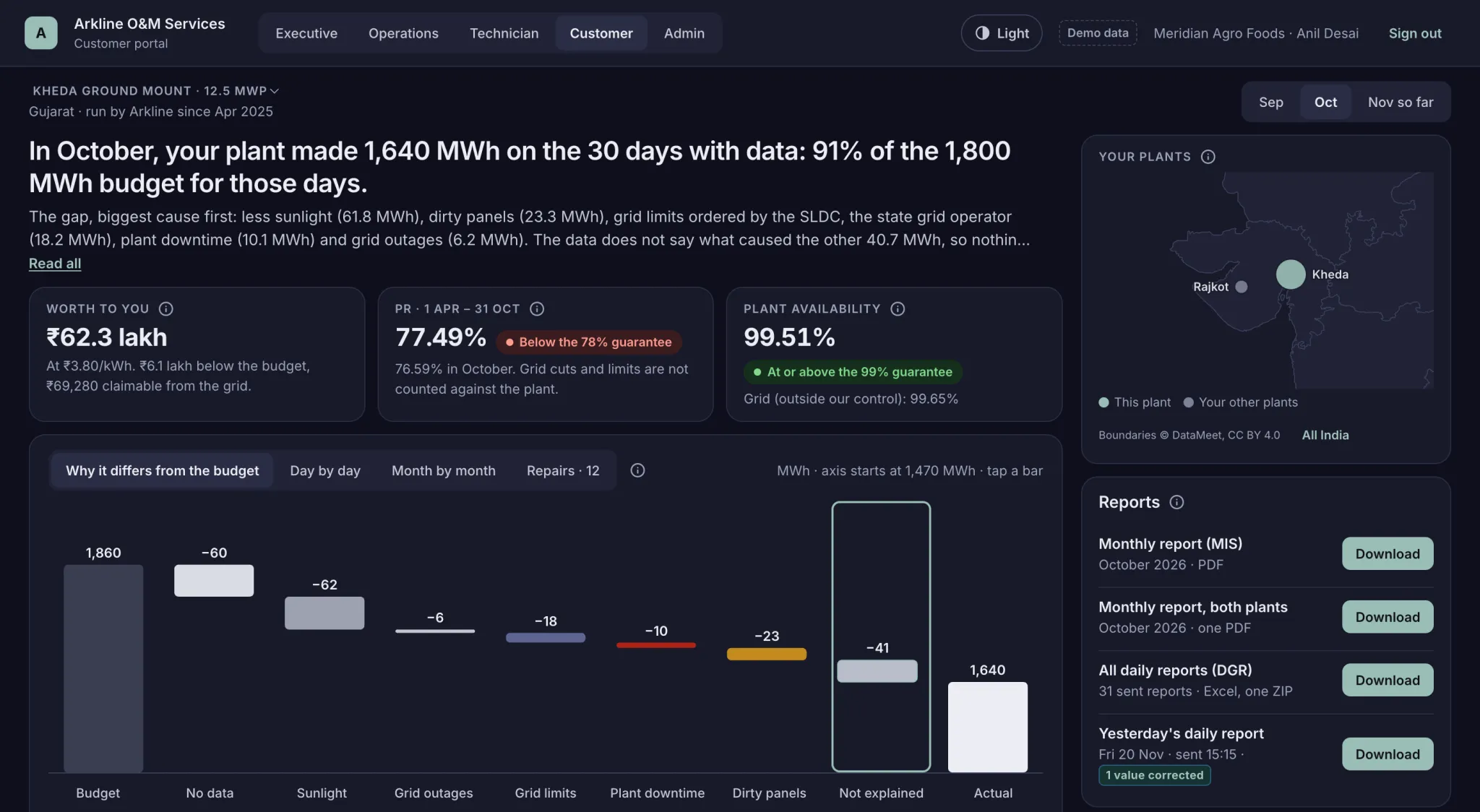
For group captive and other shared solar plants, HKDataCrest Solar records each consumer's share of the plant. Each consumer sees the plant and every energy and money figure at their share, and gets their own monthly report. Ratios such as performance ratio and availability are the plant's own and are not scaled.
The problem
Three consumers, one plant, and a monthly spreadsheet split by hand.
In a group captive plant, several consumers hold the plant together and are each credited with their share of the energy. Someone has to split every figure each month, send each consumer only their own numbers, and make sure no one sees the others'. Done by hand, it is slow, and one wrong attachment is a breach.
What it does
Shares handled once, applied everywhere.
-
Shares per plant
List the consumers and their percentages, adding up to 100. A plant with no shares belongs wholly to its one customer.
-
Figures at their share
Every energy and money figure each consumer sees is scaled to their share. PR, availability and the JMR difference in percent are not.
-
Their own report
Each consumer gets their own monthly report at their share, sent to their own list of recipients.
-
Their own login
A customer portal shows each consumer only the plants they hold. Opening anyone else's plant shows nothing at all.
Kept apart by design
Separation is enforced by the database, not by care.
Each company's data is isolated in the database itself, so a query can only ever see one company's rows. Within a company, customer users see only the plants they hold.
A customer who tries another customer's plant by its web address gets a plain not found. The page does not even show the plant's name.
Alerts can include a customer too. They are checked against the plant's shares when set up and again at every send, and the customer gets a message worded for a customer.
Worked example
A 10 MWp group captive plant with three consumers.
Take a made-up plant of 10 MWp, held by three consumers with shares of 50%, 30% and 20%. In October the export meter records 1,250,000 kWh. Three feeder trips cost an estimated 18,000 kWh and grid limits ordered by the SLDC another 12,000 kWh. The DISCOM's joint meter reading comes in 2,500 kWh below the plant's own meter. Contract PR for the month is 78.0% and plant availability 99.2%.
Here is what each consumer sees. The lost energy is valued at an example tariff of ₹4.00/kWh.
| Figure | Whole plant | Consumer A · 50% | Consumer B · 30% | Consumer C · 20% |
|---|---|---|---|---|
| Energy exported | 1,250,000 kWh | 625,000 kWh | 375,000 kWh | 250,000 kWh |
| Lost to grid outages | 18,000 kWh | 9,000 kWh | 5,400 kWh | 3,600 kWh |
| Lost to grid limits | 12,000 kWh | 6,000 kWh | 3,600 kWh | 2,400 kWh |
| Grid losses at tariff | ₹1,20,000 | ₹60,000 | ₹36,000 | ₹24,000 |
| JMR minus own meter | −2,500 kWh | −1,250 kWh | −750 kWh | −500 kWh |
| JMR difference | −0.20% | −0.20% | −0.20% | −0.20% |
| Contract PR | 78.0% | 78.0% | 78.0% | 78.0% |
| Plant availability | 99.2% | 99.2% | 99.2% | 99.2% |
All figures are made up to show the arithmetic.
Quantities split. Ratios don't.
Energy and money are quantities, so each consumer gets their share of them. Performance ratio, availability and the JMR difference in percent describe how the plant ran and how far apart two meters were. They are the same for everyone. Scale PR by 20% and consumer C would see a plant running at 15.6%, which means nothing. The product applies this rule everywhere, so nobody has to remember it at month end.
Because the shares must add up to 100%, the three consumers' energy adds back to the plant's own figure. A consumer who checks their report against the plant total finds that it reconciles.
Credited, not billed
Each consumer is credited with their share of the energy. HKDataCrest Solar works out and reports those figures. It does not raise invoices or settle banking with the DISCOM: those stay in your billing and regulatory process, which now starts from figures every party can see.
What goes wrong when it's done by hand
- The wrong consumer's workbook is attached to an email, and one company sees another's figures.
- Someone scales PR or availability along with the energy, and a consumer queries a plant that ran normally.
- A correction to the plant's figures reaches one consumer's report and not the others'.
With shares set once on the plant, every view, report and alert for each consumer comes from the same plant figures. A corrected plant figure flows into every consumer's numbers.
How it works
Setting up a shared plant.
Add the consumers
Each consumer becomes a customer, with their own users and report recipients.
Set the shares
Enter each consumer's percentage for the plant. They must add up to 100.
Run as normal
The plant is monitored and reported once. Every view is scaled per consumer.
Month end
Each consumer receives their own report, at their share.
Questions
Shared plant questions.
What is a group captive solar plant?
A plant owned jointly by several consumers who use its power for themselves. Each is credited with the share of energy that matches their stake. The rules on ownership and consumption are set by national and state regulation.
Does it work for open-access plants with several offtakers?
Yes. Any plant whose energy is shared among several customers by percentage can be set up the same way.
Why are PR and availability not scaled?
Because they describe how well the plant ran, which is the same for every consumer. Only quantities, energy and money, are split.
Can a consumer see the other consumers' figures?
No. Each consumer sees only their own share. The other consumers' names and figures are not shown to them.
Start with whatever is easiest
Tell us what's slowing your business down.
Three easy ways in. All free, all answered by the people who would do the work.
Book a 30-minute call
Talk it through with us. You leave knowing whether a pilot makes sense and what it would cover.
Get a free data check
Send us one export, such as sales, stock or orders. Within 2 working days we send back 3 things we'd fix.
How it worksSend a short note
Three quick questions: what you do, what's not working, and how to reach you.
Write to us